AKSUM–ADULIS & THE RED SEA
ውዳበ ብሔረ ኣግዓዚ (ውብኣ) — Agaezi National Union (ANU)
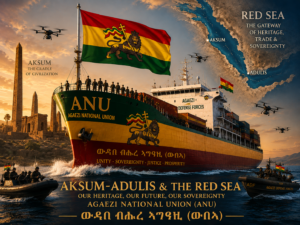
The image presents a powerful visual representation of Agaezi national identity, historical continuity, maritime heritage, and political aspiration, centered on the historic relationship between Aksum, Adulis, and the Red Sea.
At the heart of the composition is a large ocean-going vessel, symbolizing a nation looking toward the sea and reconnecting its contemporary aspirations with the ancient maritime world of the Aksumite civilization. The ship carries the initials “ANU” prominently on its hull, representing the Agaezi National Union, while the words “AGAEZI NATIONAL UNION” reinforce the organization’s identity.
The ship is painted in red, gold/yellow, and green, incorporating the colors of the displayed Agaezi flag. A prominent lion emblem carrying a cross and associated with the Ethiopian/Aksumite visual tradition appears on the flag and ship. In the composition, the lion functions as a symbol of strength, historical continuity, dignity, sovereignty, and national heritage.
Aksum and the ancient heritage
On the left side of the image are monumental Aksumite stelae and ancient architectural remains, representing Aksum as a historic center of civilization, political authority, commerce, and culture.
The inscription “AKSUM — THE CRADLE OF CIVILIZATION” connects the contemporary political vision represented by ANU with the ancient civilization that flourished in northern Ethiopia and Eritrea and maintained important connections with the Red Sea world.
The placement of the modern ship beside the ancient monuments deliberately creates a visual bridge between past and future: the ancient civilization represents historical foundations, while the ship represents movement toward a future characterized by maritime connectivity, commerce, and national development.
Adulis and the Red Sea
In the upper-right portion of the image, a stylized map identifies AKSUM and ADULIS, emphasizing the geographical relationship between the highland political center and the ancient Red Sea port.
Adulis is particularly important to the symbolism because it represents the maritime gateway through which the Aksumite world participated in Red Sea commerce and wider international trade.
The Red Sea itself is presented as more than a body of water. In the poster it symbolizes:
- Maritime connectivity
- International commerce
- Historical trade routes
- Strategic geography
- Cultural exchange
- Access to the wider world
- A connection between ancient heritage and modern aspirations
The phrase “THE GATEWAY OF HERITAGE, TRADE & SOVEREIGNTY” summarizes this idea.
The ANU vessel
The enormous ship is the dominant object in the composition. Its size conveys capacity, ambition, endurance, and national reach.
The words “UNITY – SOVEREIGNTY – JUSTICE – PROSPERITY” appear prominently along the vessel. These four concepts function as the ideological pillars of the image:
Unity — bringing people together around a shared historical and political identity.
Sovereignty — emphasizing self-determination and control over national political and economic affairs.
Justice — presenting political legitimacy, equality before the law, and accountable governance as essential national principles.
Prosperity — connecting political independence with economic development, trade, infrastructure, and improved living standards.
The Agaezi flag
The large flag flying from the ship’s mast is deliberately oversized, making it one of the most visually dominant elements of the composition. Its movement in the wind creates a sense of momentum and forward movement.
The red, gold/yellow, and green colors visually connect the ship, the maritime environment, and the broader Agaezi identity into a single composition. The lion emblem provides a distinctive historical symbol that links the modern political concept to the region’s ancient traditions.
The appearance of the same colors and emblem on the ship and smaller vessels creates visual unity, suggesting that the different elements depicted belong to a common national project.
ADF and maritime security imagery
The surrounding smaller vessels and personnel marked ADF — Agaezi Defense Forces introduce a security and defense dimension to the composition. Drones are also visible in the sky, suggesting modern surveillance and technological capability.
In symbolic terms, these elements portray the hypothetical ADF as a force intended to protect:
- territorial integrity,
- maritime interests,
- national sovereignty,
- commercial routes,
- and national infrastructure.
Because the image is conceptual, these military elements are best understood as artistic representations of a proposed or imagined defense capability, rather than documentation of an existing military force.
ውዳበ ብሔረ ኣግዓዚ (ውብኣ)
The large Ge’ez/Tigrinya inscription “ውዳበ ብሔረ ኣግዓዚ (ውብኣ)” gives the poster an additional cultural and linguistic dimension.
Its placement alongside “AGAEZI NATIONAL UNION (ANU)” visually establishes the relationship between the indigenous-language identity and its English organizational name.
This makes the poster simultaneously communicate historical identity, linguistic heritage, political organization, and international presentation.
Overall meaning
Taken as a whole, the image tells a story of historical revival and future-oriented national aspiration:
Aksum represents the past.
Adulis represents the maritime gateway.
The Red Sea represents connectivity with the wider world.
ANU represents political organization.
The Agaezi flag represents identity.
The ship represents national ambition and economic connectivity.
ADF represents the imagined protection of sovereignty.
Unity, sovereignty, justice, and prosperity represent the desired political ideals.
The central message is therefore a vision of Aksumite/Agaezi historical heritage being carried forward into a modern maritime and political future.
The image is particularly effective because it juxtaposes ancient stone monuments with a modern ship, traditional symbolism with contemporary technology, and historical memory with future aspiration. It presents the Red Sea not simply as geography, but as a symbolic bridge between heritage, commerce, political independence, and the future.
Dr. Aregawi Mebrahtu
ANU Leadership